Press Release
Yap signs a service agreement with Italy's Icarus — adapting an AI that takes the first call at medical institutions for Japan
An AI voice assistant already in use in Italian healthcare will be rebuilt to fit Japanese medical practice — starting with research
/Yap Inc.
Yap Inc. (headquarters: Shibuya-ku, Tokyo; Representative Director: Masaya Yamamoto) announces that on August 25, 2026 it signed a definitive service agreement with Icarus S.r.l. (brand name: Icarus Technology), an Italian company that develops and provides a voice assistant in which AI answers calls to medical institutions. The two companies signed a memorandum of understanding on a business partnership on May 28, 2026 (*1), and with this agreement Yap begins concrete research for the Japanese market.
Under the agreement, Yap begins the research needed to adapt the AI voice assistant service that Icarus provides to medical institutions in Italy so that it fits Japanese healthcare settings. The aim is a system in which AI handles the first response to incoming calls, sorts what each call is about, and takes appointments — so that healthcare staff can give their time to the calls that truly need a person.
Based on the results of the research, the companies will define the specification for Japan and aim for trial deployment at medical institutions. No launch date in Japan has been decided at this time.

1. Background: why bring an Italian AI into Japanese healthcare?
In Japan too, answering the phone is a burden on the people who work in healthcare. Japan has 105,690 general clinics (Ministry of Health, Labour and Welfare, "Survey of Medical Institutions (Dynamic Survey)," preliminary figure as of the end of May 2026, published July 31, 2026). At most of them, both appointments and enquiries begin with a phone call, and front-desk staff deal with the patient at the counter and the patient on the phone at the same time. Every time the phone rings, the work in hand is interrupted. In individual interviews with 12 patients and healthcare workers that Yap conducted itself in July and August 2026, ahead of this agreement (*4), call volumes differed greatly by facility, and at the busier ones the weight of that burden was described in concrete numbers. A nurse who had worked at a clinic that had already introduced web booking reported taking more than 10 calls a day herself; a medical clerk at a dispensing pharmacy (7 years' experience) reported handling 11–20 calls a day on a single phone line. By contrast, a pharmacist at an independent pharmacy (15 years' experience) reported 1–5 calls a day: the burden of the telephone varies widely from one facility to another. In a preliminary questionnaire conducted when recruiting interview participants (*5), 15 of the 20 respondents in the clinic-worker category answered that phone calls interrupting their other work is a problem "often" or "sometimes."
AI services that answer the phone automatically already exist in Japan. Several AI phone services for hospitals and clinics are already offered domestically, handling automated answering and appointment booking (*2).
At the same time, the calls a medical institution receives are not only routine appointments. Besides patient requests, sales calls and internal or business communications all arrive on the same single line. Behind an appointment request there may be a hidden question about symptoms. In the interviews described above, one front-line worker also observed that the facility with web booking received more calls, not fewer (*4). Digitising the booking channel alone may not resolve the burden of phone work (note: this is the impression of a single respondent, and it has not been separated from the possibility that facilities with web booking simply attract more patients — a larger base of callers — in the first place (*4)). The question is whether a system can take on the whole sequence — including the judgement of which call to hand to a person, and when — in a form that stands up to real-world operation in healthcare settings.
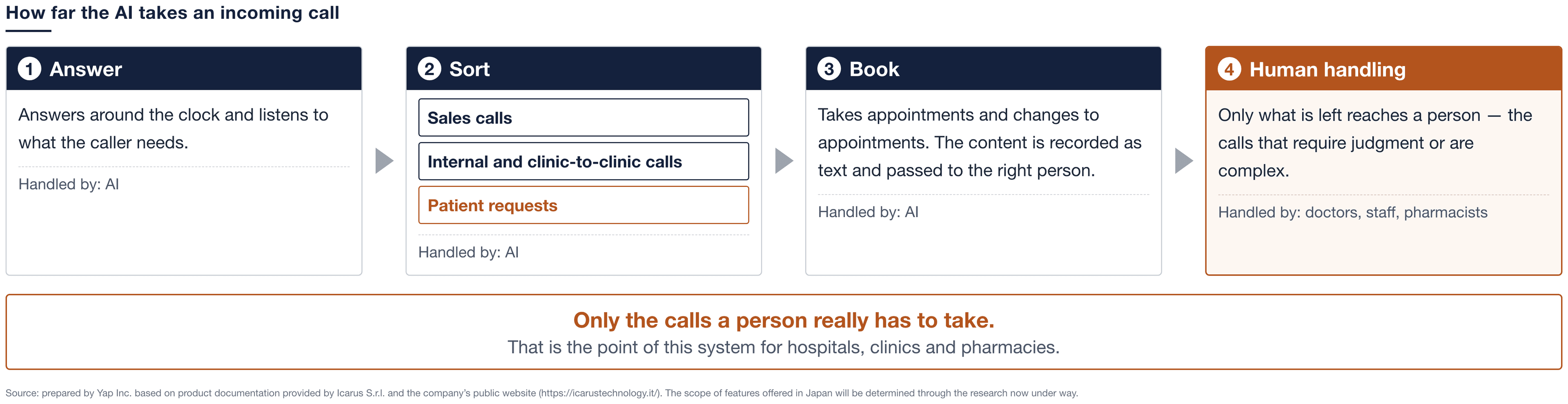
Icarus's service already carries this whole sequence at family doctors' practices in Italy. It takes on three things in a row: (1) taking the first call — answering at any hour and listening to what the caller needs; (2) sorting — separating sales calls, internal communications and patient requests; and (3) patient appointments and appointment changes. What remains, as a result, is only the calls a person really has to take. As an example of adoption, the company publishes on its own website the case of a medical practice in Genoa, Italy with five general practitioners; according to the company, the assistant "managed over 5,000 patients in just one month, with an average response time of 5 seconds," and "The result was a 95% reduction in calls" (*3).
However, the Italian specification cannot be used in Japan as it is. In Italy, every resident is assigned a family doctor, and appointments and requests for certificates all converge on that doctor's practice. In Japan, where patients choose their own medical institution, the very way calls arrive is different. In addition, because calls may contain information about symptoms and medicines, the Japanese specification must conform to Japan's rules on handling personal information and the safety-management principles for medical information systems, and must pass any call that may be urgent to a person immediately. Not misjudging urgency is a mandatory requirement of the Japanese specification.
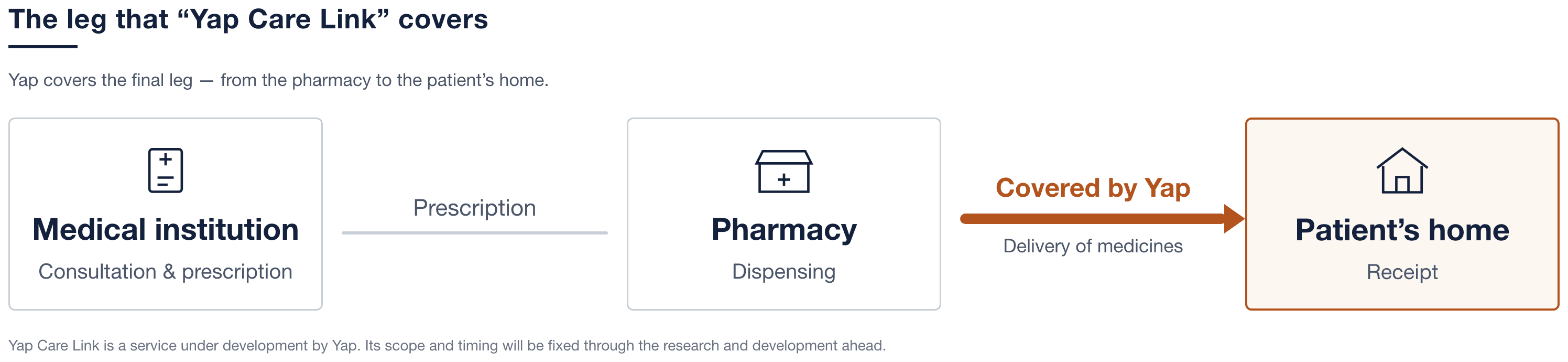
That is why Yap takes on the rebuilding for Japan — and that is what this research is. The work proceeds in three phases: (1) research into what Japanese healthcare settings actually need (started August 2026); (2) definition of the Japanese specification based on that research; (3) trial deployment at medical institutions. The agreement of August 25 covers the first phase. The results of the 12 interviews described above will be used as input in deciding which features to adapt for Japan first. The name for the Japanese market is "Kyoko AI" (the service is offered under a different name in Italy). In Japan, Yap aims to expand beyond clinics to hospitals and dispensing pharmacies (*6). In addition, linkage with "Yap Care Link," a service Yap is developing to deliver medicines to patients' homes, is one of the areas for future collaboration.
2. Why Yap — how the two companies got here
For a foreign IT company to enter Japanese medical institutions directly, there are three walls: the Japanese language, compliance with Japanese regulations, and the business customs of the healthcare field. Yap's work has been connecting overseas medical and healthcare companies to the Japanese market — including a business partnership with Asa Ren of Indonesia and an import agreement with UniMed UniHealth Pharmaceuticals of Bangladesh.
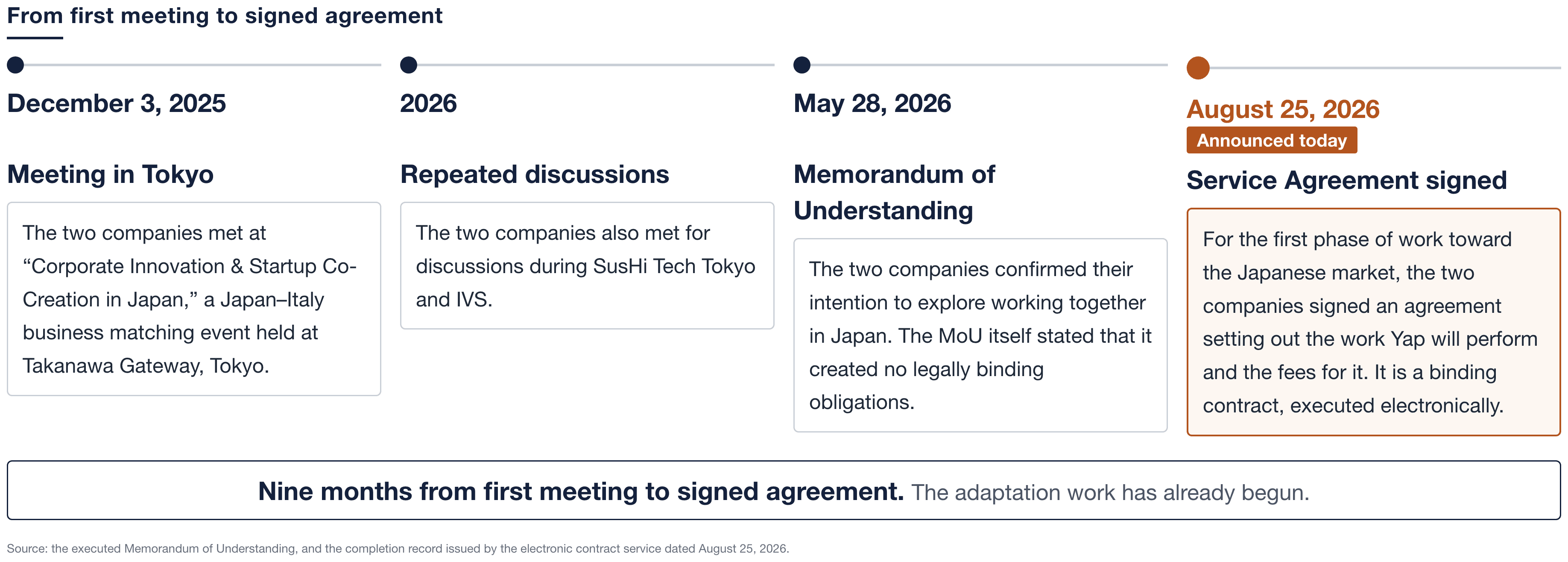
The two companies met at "Corporate Innovation & Startup Co-Creation in Japan," a Japan–Italy business matching event held at Takanawa Gateway, Tokyo, on December 3, 2025. They continued their discussions during IVS in 2026, and — with the support of the Italian Trade Agency (ITA) at the Italian Embassy and the Autonomous Region of Sardinia, and through SusHi Tech Tokyo, hosted by the Tokyo Metropolitan Government, and the venue of Tokyo Innovation Base — signed the memorandum of understanding on May 28, 2026 and the service agreement on August 25, 2026. From first meeting to signed agreement: nine months.

Masaya Yamamoto, Representative Director, comments: "In healthcare, the calls that really need to be answered are buried under the ones that don't. Only the calls that need a person get a person. I believe that alone changes the front line. What we are doing is not importing what works in Italy as it is. It is rebuilding it to fit Japanese practice. That is why the first thing we do is not selling — it is research."
3. Division of roles
| Company | Responsibilities |
|---|---|
| Icarus S.r.l. | Provision of the automated call-answering system; system maintenance |
| Yap Inc. | Research into Japanese healthcare settings; specification for Japan; liaison with medical institutions; confirmation of Japanese regulatory requirements |
4. About the companies
Icarus S.r.l. (brand name: Icarus Technology)
Address: Via Dalmazia 22, 09127 Cagliari, Sardinia, Italy / Founded: 2023
Business: development and provision of AI voice-response services for medical institutions
Service area: family doctors' practices in Italy. Entry into the Japanese market is at the research stage
URL: https://icarustechnology.it/ (English page: https://icarustechnology.it/en/home-eng/)
Yap Inc.
Address: Cosmos Aoyama South 502, 5-53-67 Jingumae, Shibuya-ku, Tokyo, Japan
Representative Director: Masaya Yamamoto
Business: supporting overseas medical and healthcare companies entering the Japanese market
5. Media coverage
This announcement was covered by the Italian business daily ItaliaOggi on September 7, 2026, under the headline "La sanità giapponese parla italiano con l'IA di Icarus Technology." https://www.italiaoggi.it/economia-e-politica/attualita/la-sanita-giapponese-parla-italiano-con-lia-di-icarus-technology-x88a4zje
(*1) The memorandum of understanding is a document confirming an intention to explore working together; the document itself stated that it created no legal obligations. The agreement of August 25, 2026 is the first phase of the two companies' collaboration; it sets out the scope of the research work Yap will perform, the fees for it, and the obligations borne by both companies. Terms of the agreement such as its value and duration have not been disclosed.
(*2) Example: ASPIC (a SaaS comparison site), "10 AI Phone Services for Hospitals and Clinics," updated August 10, 2026, https://www.aspicjapan.org/asu/article/108746 [accessed September 3, 2026]. This is an article on a comparison site operated by a business (a secondary source); Yap has not verified or compared the features of individual services.
(*3) These are statements published by Icarus. Original wording on the company's website: "…which managed over 5,000 patients in just one month, with an average response time of 5 seconds." and "The result was a 95% reduction in calls, with an overall improvement in office organization and patient satisfaction." Source: https://icarustechnology.it/en/home-eng/ [accessed September 4, 2026]. These figures have not been verified by Yap. Icarus does not disclose how the "95% reduction" is calculated (whether it refers to a reduction in incoming calls or in the calls handled by a person). The company also cites dental practices and other settings as applicable areas; this does not indicate a record of deployment.
(*4) The interviews were conducted by Yap itself in July–August 2026, as individual online interviews. The subjects were 12 people (8 on the patient side; 4 on the provider side with work experience at clinics or dispensing pharmacies). As interviews with 12 people, they do not indicate any overall trend. Call volumes in the text are as self-reported by each respondent. Individual responses have not been published. "The facility with web booking received more calls" is the impression of one respondent and does not indicate a causal relationship between web booking and call volume.
(*5) The preliminary questionnaire was administered to applicants when recruiting interview participants, and was collected in July–August 2026. The figures quoted in the text are the responses of the 20 applicants in the clinic-worker category. As responses from applicants to a study (a self-selected sample), they are not representative of healthcare workers as a whole.
(*6) What is actually in use in Italy is family doctors' practices. Expansion to hospitals and dispensing pharmacies is Yap's plan for the Japanese market and does not indicate any record of deployment.
[Media contact]
Yap Inc.
Address: Cosmos Aoyama South 502, 5-53-67 Jingumae, Shibuya-ku, Tokyo 150-0001, Japan
Contact: Masaya Yamamoto, Representative Director
Phone: (not listed in this release; please contact us by email)
Email: masaya.yamamoto@yap.co.jp